WEBSITE IS UNDER CONSTRUCTION
Field & Forge System™
Frontier Grit. Forged for Today.
The Field & Forge System is an adaptive living system rooted in historical resilience. It carries the mindset of the frontier into a world shaped by modern challenges.
Frontier life required practical knowledge, preparation, self-reliance, adaptation, trusted relationships, and the ability to continue when conditions changed. Those same capabilities remain essential wherever people face uncertainty, hardship, interrupted systems, or unfamiliar ground.
Real readiness joins what a person can carry, build, find, and do with the internal capability to perceive clearly, judge wisely, remain steady, and act when action is required.
The Field develops outward readiness through tools, knowledge, preparation, and practical experience.
The Forge develops the person who must bring those abilities to life under pressure.
The Field provides the framework. The Forge provides the foundation. Together, they create a system built to be lived today and carried into the future.
About the Physical Book
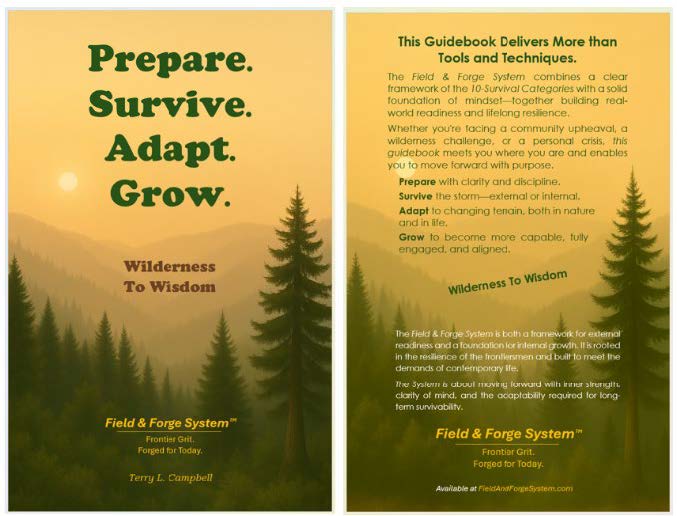 Prepare. Survive. Adapt. Grow.™ is produced as a substantial, full-color hardcover guidebook designed for study, practical use, reflection, and repeated reading.
The finished book includes:
- 256 fully developed pages
- Nearly 70,000 words
- More than 300 photographs, illustrations, charts, diagrams, and visual field examples
- A 5.5 × 8.5-inch hardcover format
- Full-colorinterior and cover printing
- 80-pound white satin text stock with a low-sheen surface
- A matte, case-wrapped hardcover
- Original photographs and author-developed charts
- Illustrations created specifically for this guidebook
- Gear images showing equipment personally used by the author
- Detailed discussions connecting tools, skills, judgment, experience, and consequence
- A complete progression from practical preparation through adaptation and internal growth
About the Book’s Content
A Whole System for Real Conditions
Survival knowledge becomes capability when its parts work together.
Prepare. Survive. Adapt. Grow. brings gear, skill, judgment, experience, and personal capability into one connected system. It begins with the practical work of preparing for wilderness travel, emergencies at home, vehicle breakdowns, evacuation, disrupted services, and prolonged conditions in which time, energy, and decisions carry real consequences.
The Field & Forge System is built upon two original structures.
The 10 Survival Categories™
They provide the external framework:
- Navigation — Compass skills and natural methods of holding direction
- Water — Containers, collection, storage, and purification
- Fire — Combustion, heat, cooking, and lighting
- Shelter — Protective clothing, shelter structure, and a functional sleep system
- Food — Calories from carried, stored, gathered, hunted, and landscape food sources
- Cutting Tools — Knife, axe, and saw
- Cordage — Rope types, natural cordage, bindings, and knots
- Communication — Relationships, planning, radio, phone, signaling, and information
- Care — First aid, hygiene, and the maintenance of tools and gear
- Defense — Protection and combat against insects, animals, and people
Together, these categories organize the essential needs, tools, knowledge, and actions that support survival and the steadiness of one’s path.
Each category affects the others. Water affects energy. Shelter affects warmth, rest, and judgment. Navigation affects time and distance. Cutting tools and cordage expand what can be built and repaired. Communication, care, and defense protect the person, the group, and the ability to continue.
Preparation becomes stronger when the categories function together.
The 10 Internal Capabilities™
These provide the foundation within the person:
- Presence — Remaining fully with what is happening
- Alignment — Meeting reality as it is
- Awareness — Noticing what is occurring
- Perception — Reading conditions accurately
- Recognition — Knowing when a pattern becomes clear
- Discernment — Judging what Recognition has revealed
- Restraint — Applying discipline before action
- Balance — Weighing competing needs and pressures, choosing wisely, and maintaining functional stability as conditions change
- Stillness — Remaining settled, attentive, and ready
- Resolve — Continuing steadily under difficulty
These capabilities allow knowledge and preparation to remain usable under pressure. They shape how clearly you perceive, how accurately you judge, how wisely you act, and how steadily you continue.
Presence establishes contact with reality. Alignment brings the whole person into workable relationship with present conditions. Awareness opens the field. Perception reads it. Recognition identifies what is becoming clear. Discernment judges it. Restraint governs action. Balance maintains function. Stillness settles unnecessary internal movement. Resolve carries the person forward.
The Field develops what you can carry, build, find, and do. The Forge develops the person who must bring those abilities to life.
The Field framework of the 10-SCs stands upon the Forge foundation of the 10-ICs.
Together, they form one living system.
Prepare for what is real. Remain functional when conditions change. Adapt with understanding. Grow through what experience teaches.
About Other Core Topics
The wilderness is one of life’s clearest teachers. It reveals relationships among weather, terrain, water, animals, energy, movement, preparation, and consequence. It also reveals the person making the decisions.
Prepare. Survive. Adapt. Grow. reaches into the living wilderness through subjects that develop observation, judgment, and functional capability:
- Weathercraft — Reading wind, clouds, temperature, pressure, silence, and changes in the activity of birds, insects, and animals
- Animal Behavior — Recognizing travel patterns, feeding activity, alarm signals, predator behavior, cover, scent, and changes within the landscape
- Stealth — Managing movement, sound, light, scent, silhouette, timing, and the use of terrain
- Covertness — Selecting travel routes and camps that reduce visibility while protecting security, resources, and long-term function
- Energy Management — Understanding how distance, weight, weather, hunger, poor sleep, fear, and prolonged effort affect the entire person
- Long-Term Survivability — Bringing water, fire, shelter, food, tools, judgment, adaptation, and sustainable daily living into continued function
- Home, Vehicle, and Evacuation Readiness — Preparing for disrupted services, breakdowns, severe weather, blocked roads, evacuation, and situations in which returning home is no longer an immediate option
- Backcountry Travel and Field-Tested Gear — Understanding what changes when established trails, mapped campsites, and nearby assistance disappear, and choosing clothing, shelter, tools, and equipment that can withstand rough country and repeated use
- Internal Barriers and Growth — Recognizing how fear, ego, pride, overconfidence, procrastination, self-doubt, avoidance, and dependence can distort judgment, and learning how to change direction without relying upon brute willpower
- Independence, Interdependence, and Leadership — Developing the capability to stand on your own, knowing when cooperation is the wiser choice, and building trust and capability within a group
- Martial Arts and Survival — Applying technique, accuracy, timing, fluidity, restraint, and practiced response when pressure leaves little time for conscious calculation
- Patterns That Travel Beyond the Wilderness — Recognizing how cycles, movement, relationships, and consequence connect wilderness experience with preparedness at home, leadership, relationships, and daily decisions
This guidebook is designed to grow with its reader.
Information becomes understanding through practice. Understanding becomes capability through experience. Each return to the book brings new experience with it, allowing relationships that once appeared separate to become clearer.
The pages remain.
The reader continues to grow through each reading.
About the Author
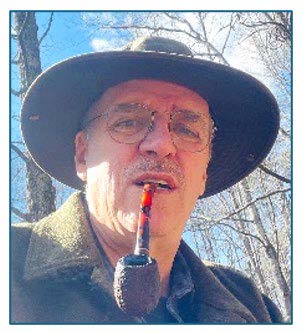 Born in 1954. His roots in the wilderness took hold during his early years with his parents and continued to deepen as he returned home regularly through college and for a time beyond. The Field & Forge System grew from those beginnings and more than seven decades of lived experience through wilderness activities, leadership, martial arts, teaching, communication, hardship, rebuilding, and close observation of the natural world.
A lifelong woodsman, fifth-degree Taekwondo master, and longtime instructor of martial arts and self-defense, Terry learned to recognize the same underlying principles across wilderness life, human conflict, disciplined training, leadership, and ordinary decisions: prepare for reality, remain functional under pressure, adapt when conditions change, and grow through experience.
His work is grounded in a simple standard: Boots on the Ground. Dirt under the Fingernails.
Understanding must eventually meet reality.
About Obtaining the Book
If the work resonates with you, send a message.
Email: Terry@FieldAndForgeSystem.com
Prepare. Survive. Adapt. Grow.™ — $... Released Soon
What the Night Reveals™ — $... Released Soon
What the Land Decides™ — $... Released Soon